Hiring takes longer than the work: scaling a team for one project
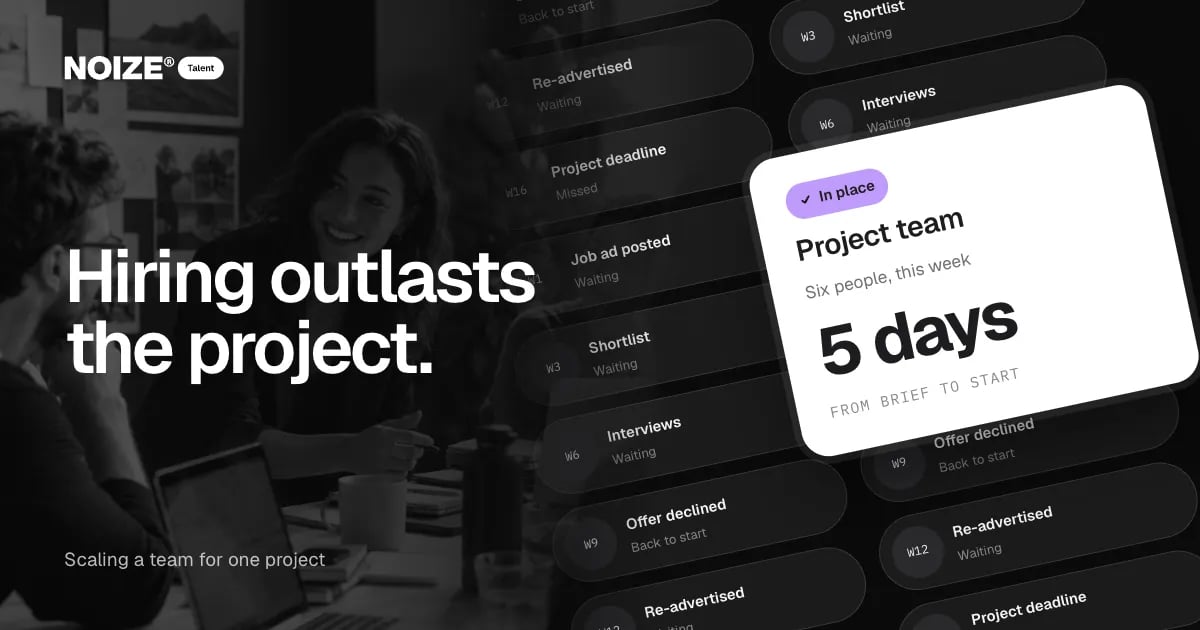
Week one: the job ad goes up. Week three: a shortlist. Week six: interviews. Week nine: the preferred candidate declines. Week twelve: the role is re-advertised. Week sixteen: the project deadline passes.
The project needs a team for six months. Hiring takes longer than the work. For a business that has just won a contract, launched a new product or taken on a major internal change, a traditional hiring process is simply too slow and too permanent for the job at hand.
The short version
- Project-based teams bring in the right people for a defined piece of work and period, without permanent hiring.
- Define the outcome, the skills, the timeline and the owner.
- Start quickly with people who have done similar work, run the project with clear milestones and capture knowledge as you go so it stays in the business.
- When the project ends, the team winds down cleanly, and you have learned which capabilities you need permanently.
Why traditional hiring doesn't fit projects
01It is slow
Advertising, interviewing, offers and notice periods take months.
02It is permanent
A six-month project doesn't need permanent staff, and redundancy at the end is costly and difficult.
03It is narrow
Projects often need several skills for different periods. Hiring one generalist rarely covers them.
04It is risky
If the first hire doesn't work out, the project timeline absorbs the delay.
How to shape a project team
01Define the outcome
What will be delivered, by when and how success is measured.
02Map the skills
List the capabilities needed and when each is needed. Some roles span the whole project; others are needed for a few weeks.
03Choose the engagement
Contract and project-based people for the core team, on-demand specialists for short bursts, and a fractional lead where senior oversight is needed.
04Name the owner
Someone inside the business owns the project, makes decisions and connects the team to the rest of the organisation.
05Set milestones
Break the project into stages with checkpoints, so progress is visible and problems surface early.
06Prepare access
Devices, accounts and systems ready before people start. NOIZE IT can handle this.
Keeping the knowledge
The risk with project teams is that knowledge leaves when they do. Plan for it from the start: document decisions and processes as the project runs, pair project people with internal staff where possible and hold a proper handover at the end. The business should finish the project more capable than it started.
> I've co-founded businesses where winning a big contract was the easy part. Staffing it fast enough was the hard part. The projects that went well used experienced project people who could start immediately, alongside a few of our own staff who kept the knowledge when they left.
“Things really got moving beyond our expectations.”
An illustrative example
Imagine an organisation rolling out a new customer platform across several states. Instead of hiring permanently, it brings in a project lead, two specialists and a trainer for six months, plus on-demand design support. Internal staff are paired with each specialist. The rollout lands on time, internal staff can run the platform afterwards and the business hires one permanent role to own it.
Mistakes to avoid
- Don't start without a defined outcome and owner.
- Don't leave knowledge capture until the final week.
- Don't keep a project team running after the project has ended.
Where Talent fits
NOIZE Talent shapes project teams around the work: the skills, the hours and the timeline. NOIZE IT readies devices and access, and NOIZE Strategy can help define the project outcome when it isn't yet clear. See talent.noize.com.au.
Questions to ask before a project starts
- What exactly will the project deliver, and by when?
- Which skills are needed, and for how long each?
- Which of those skills already exist inside the business?
- Who owns the project internally?
- What does the team need on day one: devices, access, documents?
- How will knowledge be captured as the work happens?
The answers make the team easy to shape and start.
What good looks like
The project has a clear outcome, timeline and owner. The team starts within days, with access ready. Internal staff work alongside project people. Milestones are reviewed regularly and problems surface early. Documentation builds as the work progresses. When the project finishes, the team winds down cleanly, internal staff can run what was delivered and the business knows which capabilities it needs to keep.
Where to start this week
Write down the outcome of your next major project, the skills it needs and when each is needed. Mark which skills exist inside the business. The gaps define your project team.
How Talent connects to the rest of NOIZE
Every department leans on the others, and this one is no exception. NOIZE IT readies devices, accounts and access before day one, and removes them on the last day. NOIZE Books sets up payroll correctly. NOIZE Strategy clarifies the priorities a fractional leader will own. When those departments work alongside Talent, new people arrive into a working system and deliver sooner, whether they are fractional, part-time, contract or permanent. NOIZE Sales builds the process and playbook a new salesperson walks into. NOIZE Marketing provides the plan a marketer will run.
Related reading
- The right people, without the full-time hire: fractional roles explained
- Capability now, commitment later
Common questions
What is project-based staffing?
Bringing in people for a defined piece of work and period, rather than hiring permanently.
How quickly can a project team start?
Often within days, depending on the skills required.
How do we keep knowledge after the project ends?
Document as you go, pair project people with internal staff and run a proper handover.
Can project people work alongside our staff?
Yes. Project teams usually work best embedded with internal staff.
What happens if the project scope changes?
Flexible engagements can scale up, down or change skills as the project evolves.
Is a project team more expensive than hiring?
Hourly costs may be higher, but avoiding recruitment, delays and long-term commitments often makes it cheaper overall.
Who manages the project team?
A named owner inside your business, sometimes supported by a fractional project lead.
Can a project lead to a permanent role?
Yes. Projects often show which capabilities the business needs permanently.
Can a project team work remotely?
Often, yes. Many project roles work remotely or in a hybrid arrangement, with workshops in person where useful.
What if we need the project team for longer?
Engagements can be extended, or individual roles converted to ongoing arrangements.
Can we try a role before committing?
Yes. Flexible engagements are a practical way to test a role.
What if the person isn't the right fit?
We review early and adjust the engagement or the person, so the role keeps delivering.
Do you provide executive support?
Yes. Executive and administrative support can be provided on flexible terms.
What should I tell NOIZE Talent first?
The role, the hours and how long you need it.
Your first strategy conversation is on us.
Have a chatThe brand for business.